Some things about ourselves are easier to fix than to forgive. Mine has three digits.
A confession
I’ll say the thing you’re not supposed to say out loud anymore: I don’t like my body. Not in a quirky, relatable, “ugh, Mondays” way. In a quiet, daily, grinding way that I’ve mostly learned to carry without anyone noticing.
I know the right answer. I know I’m supposed to love myself at every size, to find peace, to understand that the number means nothing and the mirror lies and worth isn’t measured in pounds. I believe all of that, intellectually, the way you believe a fact you’ve read but never quite felt. And then I step on the scale in the morning and the belief evaporates like breath on glass, and I’m right back where I started.
So this isn’t a triumphant essay. It’s not a before-and-after. It’s just honest — which, lately, feels rarer and more useful than triumphant.
The scale as a small, cruel oracle
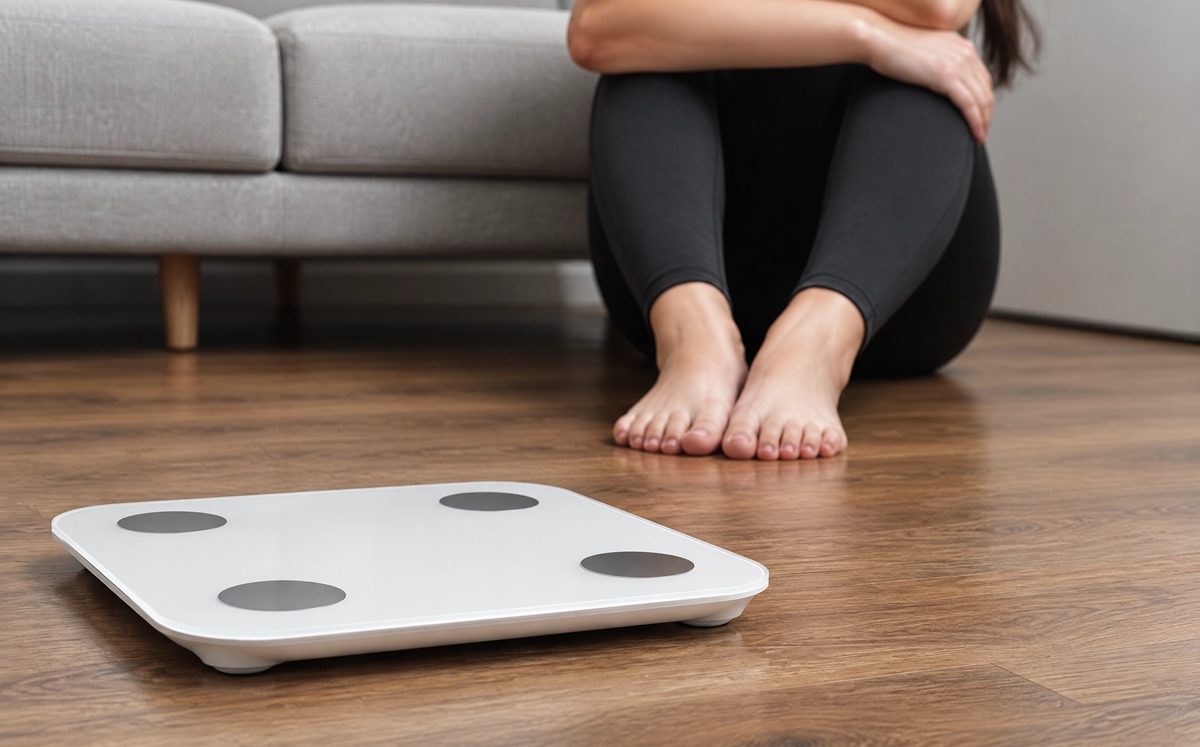
There’s a particular ritual I have with the bathroom scale, and I suspect I’m not alone in it.
I weigh myself first thing, before anything — before water, before coffee, before the day has had a chance to add anything to me. I take off everything I can. I’ve been known to remove the elastic from my hair, as if a hair tie could possibly tip the verdict. I’ll step on, step off, step on again, and take the kindest of the readings, because the scale apparently lies in both directions and I prefer the lie that flatters.
It’s absurd. I know it’s absurd. And I do it anyway, every morning, because somewhere along the way that little glass rectangle stopped being a measuring device and became something closer to a fortune teller. It doesn’t just report a number. It hands me a mood for the day. Down half a pound, and the morning has a quiet lightness to it. Up two, and there’s a low static of disappointment under everything, all the way to lunch.
I have given a piece of furniture the power to decide whether I get to like myself today. Written down, it sounds insane. Lived, it feels completely normal — which is maybe the most honest thing I can tell you about all of this.
How I got here
I didn’t always live like this. There was a version of me, years ago, who barely thought about it — who ate when hungry, stopped when full, and moved through the world without keeping a running tally.
I’m not entirely sure when the tally started. It crept in slowly, the way these things do — a comment here, a tighter waistband there, a photo I didn’t recognize myself in. Life happened to my body the way it happens to everyone’s: time, stress, the slow accumulation of ordinary years. And somewhere in there, my body stopped being the thing I lived in and became a thing I managed, a project with a metric, a problem I was apparently failing to solve.
The cruel part is that the more I focused on it, the worse the focusing made everything. The watching bred anxiety, and the anxiety bred exactly the behaviors — the late-night eating, the all-or-nothing dieting, the shame spirals — that made the watching feel justified. A perfect, closed loop, feeding itself.
The thing nobody tells you about “just love yourself”
Here’s where I’m supposed to arrive at self-acceptance, tie it up, and tell you I made peace with it.
I haven’t, fully. And I’ve come to think the “just love your body” advice, however well-meant, sometimes misses something true. It treats self-acceptance like a switch you can flip if you just decide to — and when you can’t flip it, you end up with a second failure stacked on the first. Now you’re not only unhappy with your body; you’re also bad at loving it. Even your self-acceptance is something you’re getting wrong.
What’s actually helped me isn’t loving the number. It’s slowly, unevenly, loosening the number’s grip — which is a different and more honest project. Not “I love what the scale says,” but “the scale doesn’t get to be the oracle anymore.” Some mornings I manage it. Some mornings I take the hair tie out and go for best-of-three like always. Progress here isn’t a straight line; it’s a long, gentle argument with yourself that you don’t always win.
What I’m learning to hold instead
A few things have started to shift the ground a little, and none of them is dramatic.
I’ve started measuring different things. Not the number, but whether I have more energy than I did. Whether I slept. Whether my body did something I was proud of rather than weighed something I approved of. These are quieter signals, and they don’t fit on a glass rectangle, but they’re truer reports of how I’m actually doing.
I’ve started noticing the loop — the way the watching feeds the anxiety feeds the behavior — and sometimes, not always, catching it before it closes. Just seeing it is something. You can’t interrupt a pattern you can’t see.
And I’ve started being, if not kind to myself, at least a little less cruel. Treating a bad morning as information instead of a verdict. Because the shame never once helped. Not once. It just made the next bad morning more likely. That’s not a moral insight; it’s almost a mechanical one. Cruelty toward yourself is a strategy, and it’s a strategy that doesn’t work.
Why I’m telling you this
I’m writing this partly because I needed to, and partly because I suspect a lot of people are quietly living some version of it — performing self-acceptance in public while doing the hair-tie ritual in private, believing the right things and feeling none of them.
If that’s you, I don’t have a tidy fix to hand you. I’m not on the other side of this; I’m somewhere in the middle of it, writing from inside the fog rather than from the clear air beyond it. But I’ve found there’s an odd relief in just saying the true thing out loud: I don’t love this, and pretending I do hasn’t helped. The honesty itself loosens something.
Maybe that’s the whole of what I have to offer. Not “love your body.” Just: you’re allowed to find this hard. You’re allowed to want to change something and to stop hating yourself in the meantime — those two things can be true at once, even though everyone acts like you have to pick one. Making peace with the contradiction, it turns out, is its own kind of progress.
The scale will still be there tomorrow morning. I’ll probably still take the hair tie out. But I’m trying, slowly, to walk in already knowing the one thing the number can’t tell me: that the day was always going to be worth more than three digits, whatever they happened to say.